2026. 7. 30. 09:07ㆍ카테고리 없음
You signed up for it during onboarding, clicked through a few screens, and never thought about it again. That's employer life insurance for most people — a quiet checkbox benefit, not something you actively manage.
Which is exactly why it's worth a second look.
Quick answer: Employer life insurance — usually one to two times your salary — tends to fall short once you have a mortgage, dependents, or debt that would outlast a modest payout. Financial guidance commonly points to 10–15 times annual income as a fuller target. If your family's needs are bigger than your group policy, a personal term policy can close the gap.
Here's how to figure out where you actually stand.
Table of Contents
- What Your Employer's Coverage Actually Buys You
- How Much Life Insurance Do You Actually Need?
- Life Events That Push You Past What Employer Coverage Offers
- The Job-Change Problem: What Happens If You Leave
- Employer Coverage vs. Individual Life Insurance
- Signs You've Outgrown Your Group Policy
- Closing the Gap Without Overspending
- FAQ
What Your Employer's Coverage Actually Buys You
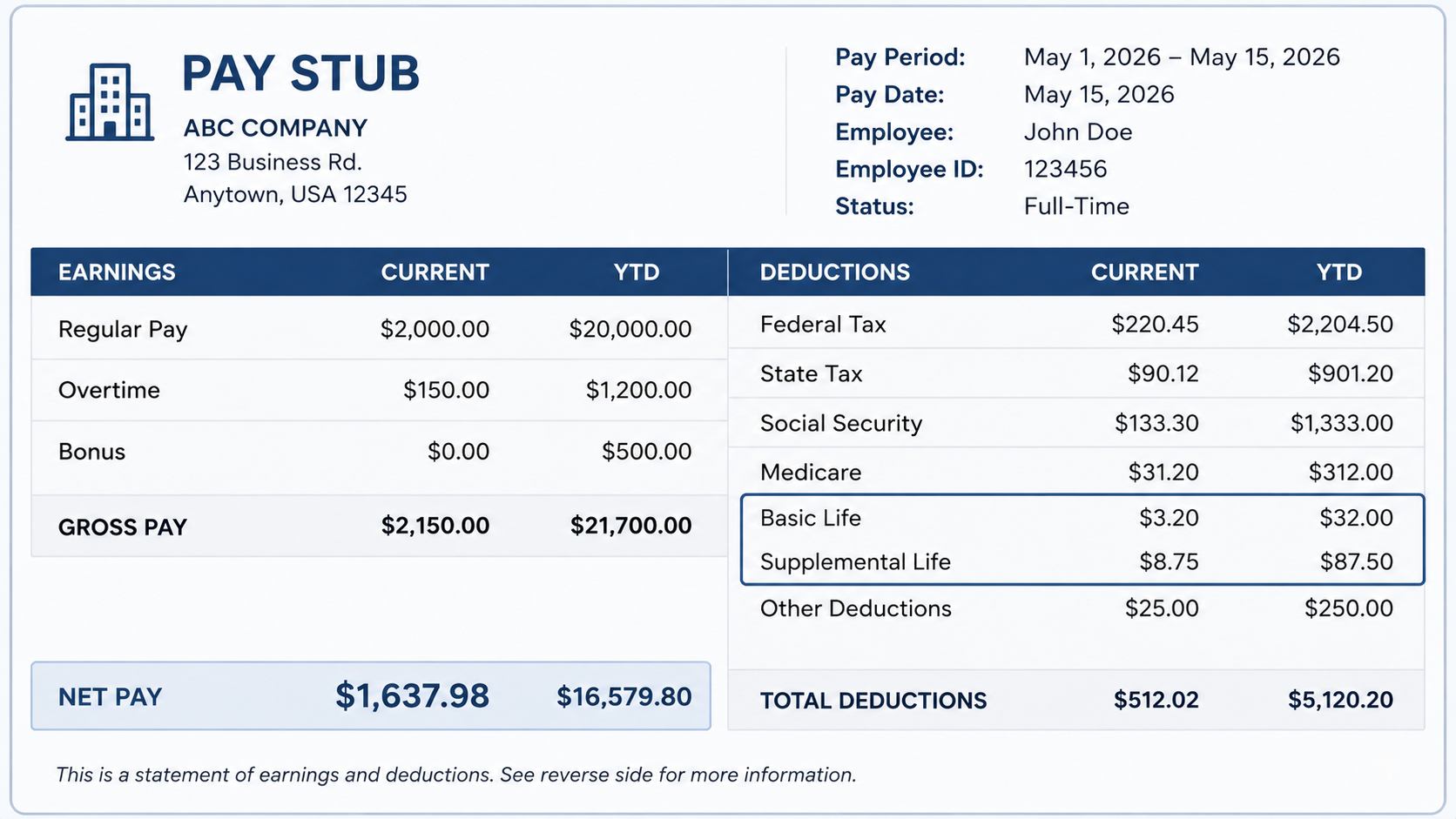
Group life insurance is usually one of two things: a flat amount, often somewhere between $25,000 and $100,000, or a multiple of your annual salary — most commonly one times, sometimes two.
Employers offer it because it's cheap and easy. There's no medical exam. No health questionnaire that could get you rejected. Everyone at the company who signs up during the enrollment window gets in, healthy or not. That's the appeal.
There's a tax detail worth knowing, too. Under IRS rules, the first $50,000 of employer-paid coverage is tax-free. Anything the company pays for above that gets added to your taxable income as "imputed income" on your W-2. It's a small line item, but it explains why many plans are capped right around that number.
Some employers also let you buy supplemental coverage through payroll deduction — often up to three or four times your salary. It's still cheaper than shopping independently, though you may need to answer a few health questions for the higher tiers.
How Much Life Insurance Do You Actually Need?
There's no single right number — it depends on your debts, your dependents, and your income. But two approaches show up again and again in financial planning circles.
The simplest is the income multiple: take your annual salary and multiply it by 10 to 15. A $60,000 earner would land somewhere between $600,000 and $900,000. Quick, but rough — it doesn't account for what you actually owe or how many kids you're funding through college.
The more detailed version is the DIME method, which adds up four categories:
- Debt — credit cards, auto loans, student loans (anything but the mortgage)
- Income — your salary multiplied by however many years your family would need replacement income
- Mortgage — your remaining home loan balance
- Education — estimated future costs for any kids you're planning to put through school
Add those four together, subtract whatever coverage you already have, and the remainder is your gap.
Neither method is a substitute for talking to a licensed insurance agent or financial planner about your specific situation — but both give you a number to compare against that "1x salary" employer policy. For most people, the comparison isn't close.
Life Events That Push You Past What Employer Coverage Offers
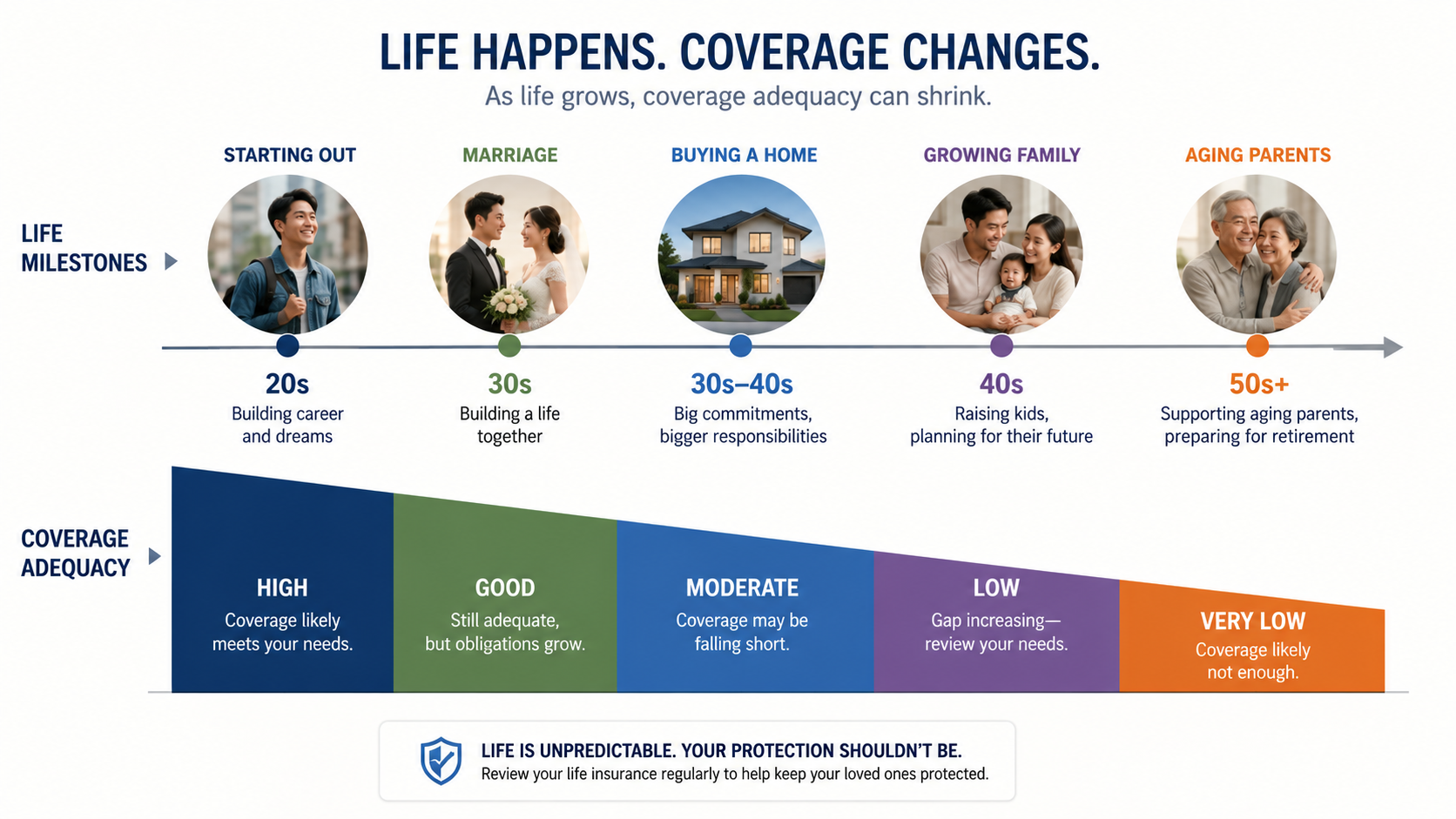
A flat $50,000 policy might have been plenty the year you started your first job, fresh out of school with no dependents. Life tends to add obligations faster than group coverage adds zeros.
Watch for these turning points:
- You got married, and your household now runs on two incomes — or is about to become dependent on one.
- You had a kid (or another one). Diapers today, tuition down the road.
- You bought a house. A mortgage is debt with your name on it for the next 15–30 years.
- You became the primary earner, whether by choice or because your partner stepped back from work.
- You took on business debt or co-signed a loan for someone else.
- You're supporting aging parents, which adds a second dependent relationship most people don't plan for.
None of these automatically means your employer plan is now useless. But each one raises the stakes of what happens if that plan is all you have.
The Job-Change Problem: What Happens If You Leave
Here's the part people find out the hard way: group life insurance is tied to your job, not to you. Quit, get laid off, or retire, and the policy typically ends the day your employment does.
Some plans offer a lifeline in the form of two options, though not every plan includes them:
- Conversion — you turn your group coverage into an individual permanent (usually whole life) policy, no medical exam required. It's guaranteed, but premiums are typically higher than what you'd pay on the open market.
- Portability — you keep something closer to your original term coverage, paying premiums directly to the carrier instead of through payroll. It's usually cheaper than conversion, but most portability provisions cut off around age 70 to 80.
The catch with both: you generally have a narrow window — often around 30 days — to apply after your coverage ends. Miss it, and the option disappears.
If you have a health condition that would make new coverage expensive or hard to get elsewhere, this window matters enormously. It's worth checking your certificate of coverage now, before you're in the middle of a job change and scrambling.
Employer Coverage vs. Individual Life Insurance
| Employer (Group) Coverage | Individual (Personal) Policy | |
| Typical amount | 1–2x salary (up to 3–4x with supplemental) | Whatever you apply for and qualify for |
| Underwriting | Usually guaranteed, no exam | Medical exam or health questions common |
| Cost | Low, often subsidized by employer | Depends on age, health, coverage amount |
| Portability | Ends or changes when you leave the job | Stays with you regardless of employer |
| Rate lock | Can rise with age or job changes | Term policies lock in a rate for the term length |
| Best for | A no-cost baseline everyone should keep | Filling the real gap in coverage needs |
Neither one is "better" across the board — they solve different problems. Group coverage is a free floor. An individual policy is the part you actually control.
Signs You've Outgrown Your Group Policy
A quick gut check. If more than one or two of these sound familiar, it's worth running the numbers:
- Your group coverage is less than 5x your annual income
- You have a mortgage, car loan, or student loan balance bigger than your payout would cover
- You have kids who'd need years of support, or education costs, if your income disappeared
- You're the sole or primary earner in your household
- You've had health changes that could make future coverage harder to get
- You've never actually calculated what your family would need — you just have "whatever the job gave me"
Closing the Gap Without Overspending
The good news: filling the gap doesn't have to mean overhauling your finances.
Term life insurance is the standard tool for this. It's straightforward — you pick a coverage amount and a term length (10, 20, or 30 years are common), pay a fixed premium, and the policy pays out if you die within that window. No investment component, no cash value to manage. Just protection.
A common strategy is "laddering" — buying a couple of smaller term policies with different lengths instead of one big one. A 20-year term might cover the years your mortgage and kids' expenses overlap, while a shorter 10-year term adds extra protection during your highest-debt years, then drops off once things ease up.
The best time to buy is now, while you're younger and healthier, since age and health are the two biggest factors in what you'll pay. Waiting doesn't make the decision easier — it usually just makes coverage more expensive.
Before buying anything, get quotes from a few carriers, and be honest on the health questionnaire. It's tempting to treat this as one more form to click through — like your employer policy was. It isn't.
FAQ
Is my employer's life insurance enough to protect my family? For most people with a mortgage, kids, or significant debt, probably not. A typical employer policy covers 1–2x your salary, while common financial guidance points to 10–15x income as a fuller target. Run your own numbers using the DIME method to see where your gap actually is.
How much life insurance does an employer typically provide? Most basic group policies provide either a flat amount (often $25,000–$100,000) or one times your annual salary. Some employers offer supplemental coverage on top of that, up to three or four times salary, usually through payroll deduction at an added cost.
What is the DIME method? DIME stands for Debt, Income, Mortgage, and Education. You add up your non-mortgage debts, the years of income your family would need replaced, your remaining mortgage balance, and future education costs. The total, minus any coverage you already have, is your estimated gap.
Can I buy additional life insurance through my employer? Often, yes. Many employers offer voluntary supplemental life insurance through payroll deduction, sometimes up to three or four times your salary. It's usually cheaper than an individual policy, though larger amounts may require answering health questions.
What happens to my employer life insurance if I quit or get laid off? It typically ends on your last day of employment unless your plan includes conversion or portability options. Without one of those, your coverage simply stops — there's no COBRA-style continuation for life insurance the way there is for health insurance.
What's the difference between conversion and portability? Conversion turns your group coverage into an individual permanent policy without a medical exam, usually at a higher premium. Portability lets you keep something closer to term coverage at your own expense, generally cheaper, but it often ends by age 70–80.
Do I pay tax on employer-provided life insurance? The first $50,000 of employer-paid group life insurance is tax-free under IRS rules. Anything your employer pays for above that amount is treated as imputed income and shows up as taxable income on your W-2.
Should I get life insurance outside of work if I already have group coverage? If your group coverage alone wouldn't cover your family's real needs — a mortgage, income replacement, education costs — then yes, an individual policy is worth considering as a supplement, not a replacement.
Is group life insurance cheaper than buying my own policy? Often, yes, per dollar of coverage, especially since your employer usually subsidizes part or all of the cost and there's no individual underwriting. But it's typically capped lower than what a family actually needs, and it doesn't travel with you if you change jobs.
What if I have a health condition — can I still get more coverage? Group supplemental coverage may still be available with simplified or no underwriting up to certain limits, which can help. If you're shopping for an individual policy with a health condition, premiums may be higher, but many carriers still offer coverage — comparing multiple quotes helps.
How long do I have to convert or port coverage after leaving a job? It varies by plan, but a window of around 30 days after your coverage ends is common. Check your certificate of coverage or ask HR before you leave, since missing the deadline usually means losing the option entirely.
When should I buy supplemental or individual life insurance? The best time is while you're younger and healthier, since age and health status are the two biggest factors in your premium. Waiting until a life event forces the issue — a new mortgage, a new baby — often means paying more for the same coverage.
Conclusion
Employer life insurance isn't a bad benefit. It's just a smaller one than most people realize, and it comes with fine print about what happens the moment you leave the job.
The fix isn't complicated: figure out your actual number using a method like DIME, compare it against what your group plan provides, and decide whether the difference is worth closing with a personal policy. For most people with a mortgage, kids, or a partner depending on their income, it is.
Call to action: Pull up your most recent benefits summary and check two things — your current coverage amount, and whether your plan mentions conversion or portability. Then run your own DIME estimate to see how the numbers compare.